

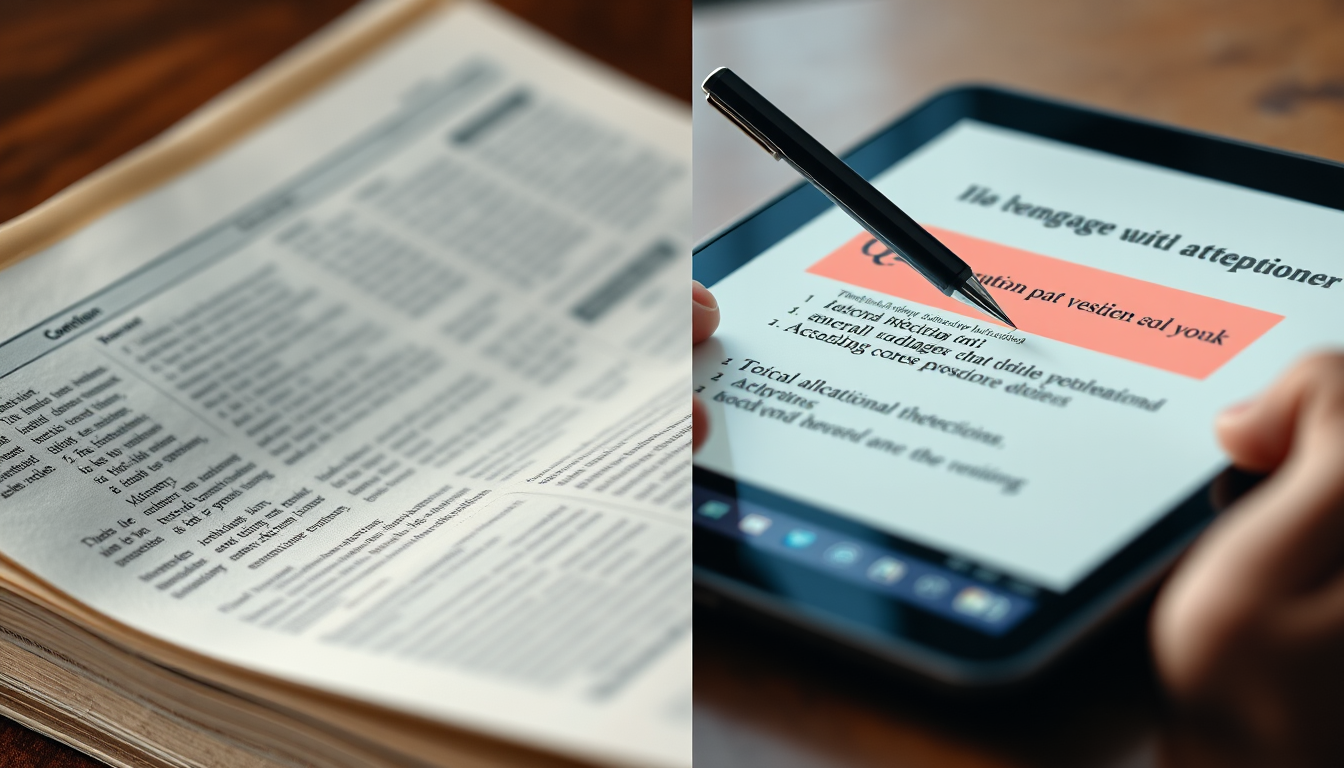
Do we actually want models that can transcribe every single word of a 50-page PDF? Yes, but only if we enjoy watching them hallucinate the moment they hit a complex table or a weirdly formatted footer.
For a long time, the industry assumption has been that the path to a better Large Multimodal Model (LMM) is simply more data and more rigorous “transcription” training. The idea is simple: make the model look at a page and write out exactly what it sees. It’s a brute-force approach to visual understanding. But a recent study from ByteDance suggests we’ve been training our models to be glorified secretaries rather than actual analysts.
The research, focusing on their “Seed” framework, finds that training a model to answer specific questions about a document is significantly more effective than forcing it to transcribe the text. The real kicker is the scale. They found that a 7B model trained this way could handle documents four times longer than anything it saw during training, often outperforming models that are vastly larger.
If you haven’t seen the details, the ByteDance study essentially argues that transcription is a trap. When a model is trained primarily to transcribe, it treats the document as a linear sequence of characters (it’s basically a fancy OCR task). When it’s trained via Question and Answering (QA), it has to develop a spatial and semantic understanding of where information lives and how it relates to the query.
It is the difference between a student who spends four hours copying a textbook word-for-word and a student who spends four hours taking a practice exam. One is performing a mechanical task; the other is learning how to retrieve and synthesize information.
The transcription trap
This is a massive win for anyone who doesn’t have a cluster of H100s in their basement. For the local-inference crowd, the 7B parameter class is the sweet spot. It’s the threshold where a model becomes genuinely useful without requiring a corporate budget to boot up.
When we look at the current open-weights pecking order, we’re seeing a lot of noise around the Llama 3.2 Vision and Qwen2-VL models. Both are impressive, but they still struggle with “needle in a haystack” problems in massive, image-heavy PDFs. If ByteDance’s findings are integrated into the next wave of open-weights releases, the 7B class might stop being the “small” option and start being the “optimal” option.
From a deployment perspective, a 7B multimodal model is a dream for the consumer rig. On a 3090 or 4090 with 24GB of VRAM, you can run these models with plenty of headroom for a massive context window. If you’re using GGUF quants via llama.cpp or Ollama, or perhaps EXL2 for faster tokens-per-second, you can fit the model and the visual embeddings comfortably without hitting the swap file. Even on a Mac M3 or M4 Ultra, the unified memory makes this kind of long-document analysis trivial.
The problem with the current “transcription-first” models is that they eat tokens for breakfast. If a model has to internally transcribe a page before it can answer a question, your context window disappears instantly. By shifting the training objective to QA, we move toward models that can “glance” at a document and extract the answer without needing to rebuild the entire text in their hidden states.
Bigger isn’t smarter; it’s just more expensive to run.
We’ve seen this movie before. Everyone thought we needed 70B+ models for complex reasoning until the quantization and fine-tuning community proved that a well-trained 7B or 8B model could punch way above its weight class. Now we’re seeing the same thing happen with multimodal capabilities. The bottleneck isn’t the parameter count—it’s the training objective.
By Q2, we will see a wave of 7B-class multimodal models that ditch transcription-heavy pre-training in favor of this QA-centric approach, effectively killing the need for massive vision-language models for most document-processing tasks.
If the open-weights community adopts this, the “VRAM wall” becomes a lot less intimidating. We don’t need a 100B model to read a financial report; we just need a 7B model that wasn’t trained to be a typewriter.








Leave a Reply