

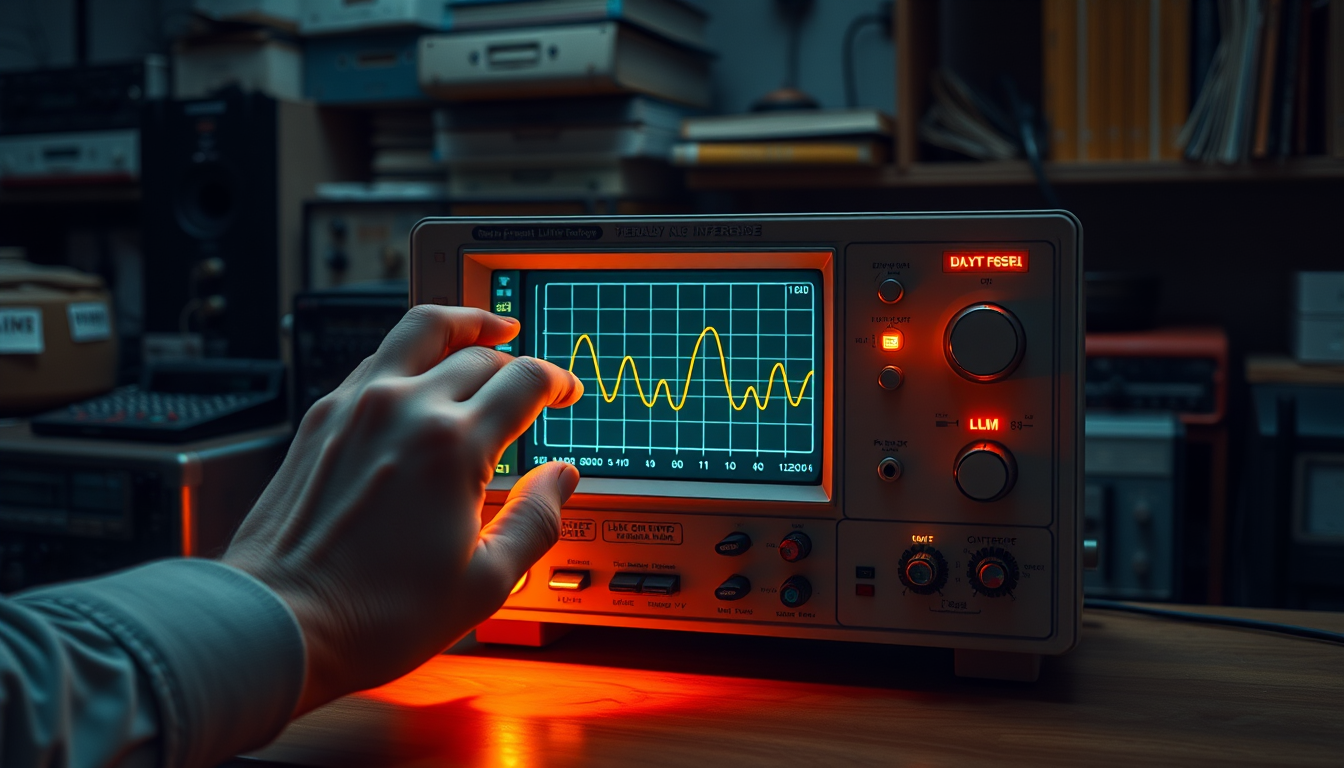
It is 3:14 AM. A developer is staring at a terminal window, watching a long-context prompt crawl across the screen at a miserable 1.2 tokens per second. The VRAM on their 3090 is topped out, the fans are screaming, and the model is effectively choking on its own memory. Who actually enjoys watching their throughput plummet just because the conversation got a bit long?
The memory bandwidth wall
- Dynamic termination of the attention sum during the decoding phase.
- Reduction in memory bandwidth requirements by avoiding redundant KV cache fetches.
- Avoidance of static, pre-decoding pruning that often kills model coherence.
- A focus on the runtime cost of fetching keys and values rather than just the storage.
The KV cache is essentially a tax we pay for long-context windows. Once you push past 32k tokens, the GPU isn’t actually struggling with the math—it’s struggling to move data from memory to the cores. This is the memory bandwidth wall. It is a bit like trying to cook a gourmet meal in a kitchen where the fridge is in another building; you spend more time walking back and forth to get ingredients than you do actually chopping vegetables. Most people try to solve this by pruning the cache before they even start decoding, which is like a chef throwing away half the ingredients before they start cooking and hoping the dish still tastes right. It’s a blunt instrument that often results in the model losing the plot entirely.
ART, as detailed in arXiv:2606.00024, takes a different approach. Instead of guessing what to delete in advance, it stops the attention calculation the moment the result is “good enough.” It is more like a chef tasting a soup—once the flavor is there, you stop adding salt. By terminating the process at runtime, the system avoids fetching unnecessary parts of the KV cache from VRAM. (Or maybe it’s just my aging hardware that makes this sound like a miracle). If this moves from a research paper into actual inference kernels, it could significantly move the needle for anyone running local weights.
The real question is whether this survives the trip to a consumer rig. If ART requires custom CUDA kernels that only play nice on H100s, it’s a curiosity, not a tool. But if it gets integrated into vLLM, sglang, or llama.cpp, we are looking at a genuine boost in tokens per second for the 4090 crowd. Currently, running Llama 3.3 or Qwen 2.5 at high context requires aggressive quantization—think GGUF Q4_K_S or EXL2—just to fit the KV cache into 24GB of VRAM. If you are on a Mac M3 or M4 Ultra with 128GB of unified memory, you have the space, but you still hit the bandwidth ceiling. If we can reduce the bandwidth pressure during the actual fetch, we might actually be able to use larger quantizations without the speed hitting a brick wall.
As for the “can I run this” question: the minimum spec remains the same—you still need to fit the weights—but the comfortable spec for long-context shifts. Right now, a 3090 is barely enough for a 70B model at 4-bit with any real context. ART could potentially make a 3090 feel like a 4090 in terms of long-context fluidity. Regarding the license, the paper is an academic release, meaning the logic is out there for the community to pick up. There is no restrictive corporate license gating the math here, which usually means the race to implement it in Ollama or MLX starts now. We’ve seen this pattern before with speculative decoding; the researchers prove it, and the community optimizes it into the ground. We will see a community-driven implementation of ART in llama.cpp or vLLM by Q4.
A clever optimization that only matters if the kernels are portable.












Leave a Reply