
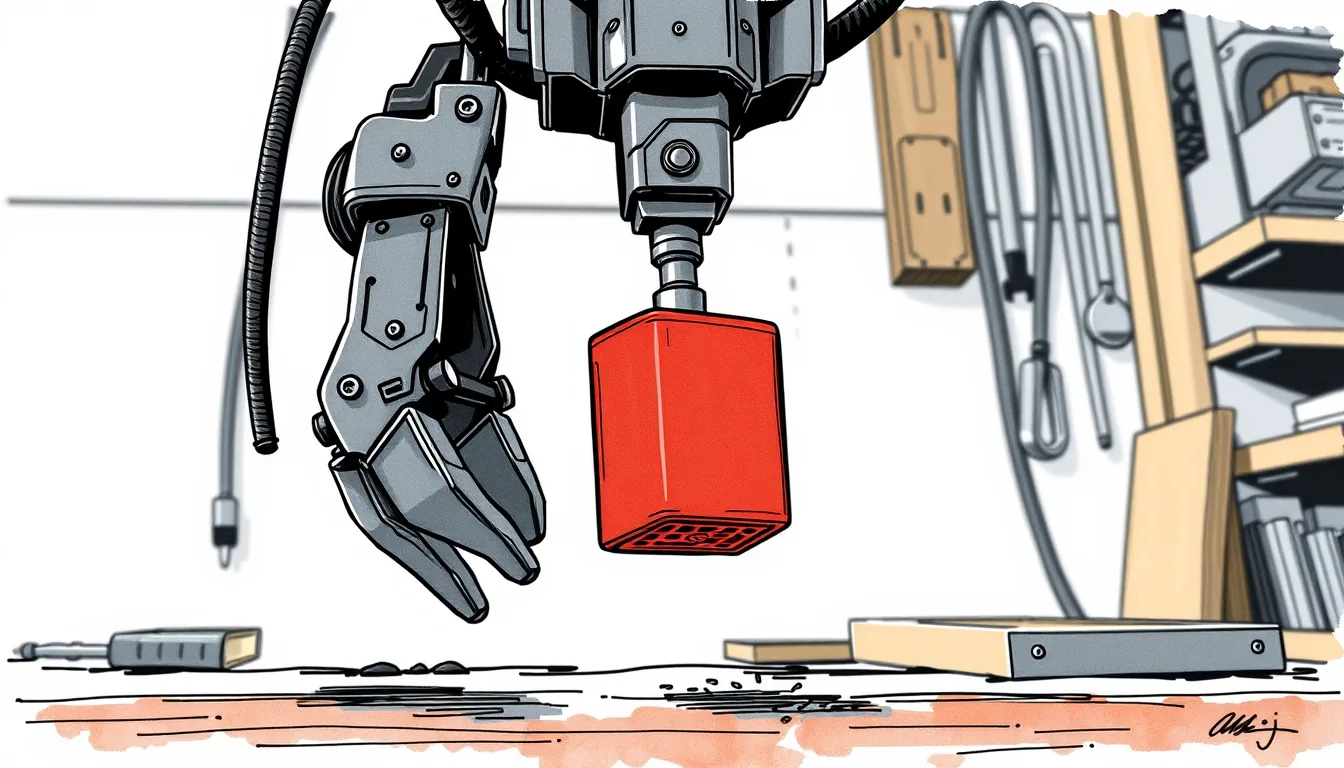
100,000. That is roughly the number of training samples usually required before a robotic arm stops knocking over the glass it is trying to pick up. In the world of LLMs, we just throw more tokens at the problem until the hallucinations stop. In robotics, you can’t just “download” more physical reality. You have to actually move a piece of metal in a physical room, and that is where the friction starts.
Hugging Face is trying to solve this by turning robotics into a software problem. Their LeRobot v0.6.0 release isn’t just a version bump; it is an attempt to build the “PyTorch of Robotics.” The goal is to standardize how we collect data, train models, and move those models from a simulation into a physical arm without the whole thing crashing into a wall.
The core of the new release is a loop: Imagine, Evaluate, Improve. For those who haven’t spent their weekends fighting with ROS (Robot Operating System), this is essentially an attempt to create a feedback loop for physical intelligence. “Imagine” refers to generating synthetic data in simulation. “Evaluate” means testing that data against real-world physics. “Improve” is the fine-tuning stage where the model actually learns from its mistakes.
It is a clean workflow on paper. In practice, it is like trying to learn to play the piano by reading a manual and then spending ten hours a day practicing on a keyboard that occasionally forgets how to be a keyboard. The sim-to-real gap is a persistent nightmare. You can simulate a gripper perfectly in a virtual environment, but the moment a real-world LED light creates a weird reflection on a plastic cup, the model panics.
Why are we still pretending that simulation is a 1:1 replacement for reality? (Or maybe I’m just cynical because I’ve seen too many demo videos that use hidden magnets). The “Imagine” part of the loop is only as good as the simulator’s ability to mimic the chaos of a real room. If the simulation is too clean, the robot becomes a fragile specialist that can only function in a vacuum.
The real bottleneck isn’t the architecture—it is the data. LLMs have the entire internet to feast on. Robots have a handful of carefully curated datasets and a few dozen people in labs wearing VR goggles to record “teleoperation” data. This is the “robot data problem” that LeRobot is trying to attack by making data collection and sharing as easy as uploading a model to the Hub.
If Hugging Face can actually standardize the data format for robotic trajectories, we stop wasting time on plumbing and start focusing on scaling. But here is the catch: software is free to distribute, but hardware is expensive to scale. You can’t just spin up 1,000 H100s in the cloud to get more robot data. You need 1,000 physical arms, 1,000 tables, and a lot of electricity. The cost of the hardware (and the latency of the controllers) remains the ultimate ceiling.
The ambition here is to democratize the field so that a developer with a cheap 3D-printed arm can contribute to a global dataset. It is a noble goal, but the quality of data from a hobbyist arm is worlds apart from a professional-grade industrial robot. Even so, the move toward an open ecosystem is the only way to break the monopoly held by the few labs that can actually afford a fleet of a thousand robots.
It is a software win and a hardware headache.
Within 12 weeks, we will see the first community-driven benchmark that actually penalizes sim-to-real drift in a meaningful way, forcing developers to stop bragging about simulation scores. Until then, LeRobot is a great toolkit for people who enjoy the thrill of watching a $2,000 arm slowly decide to delete its own motherboard.