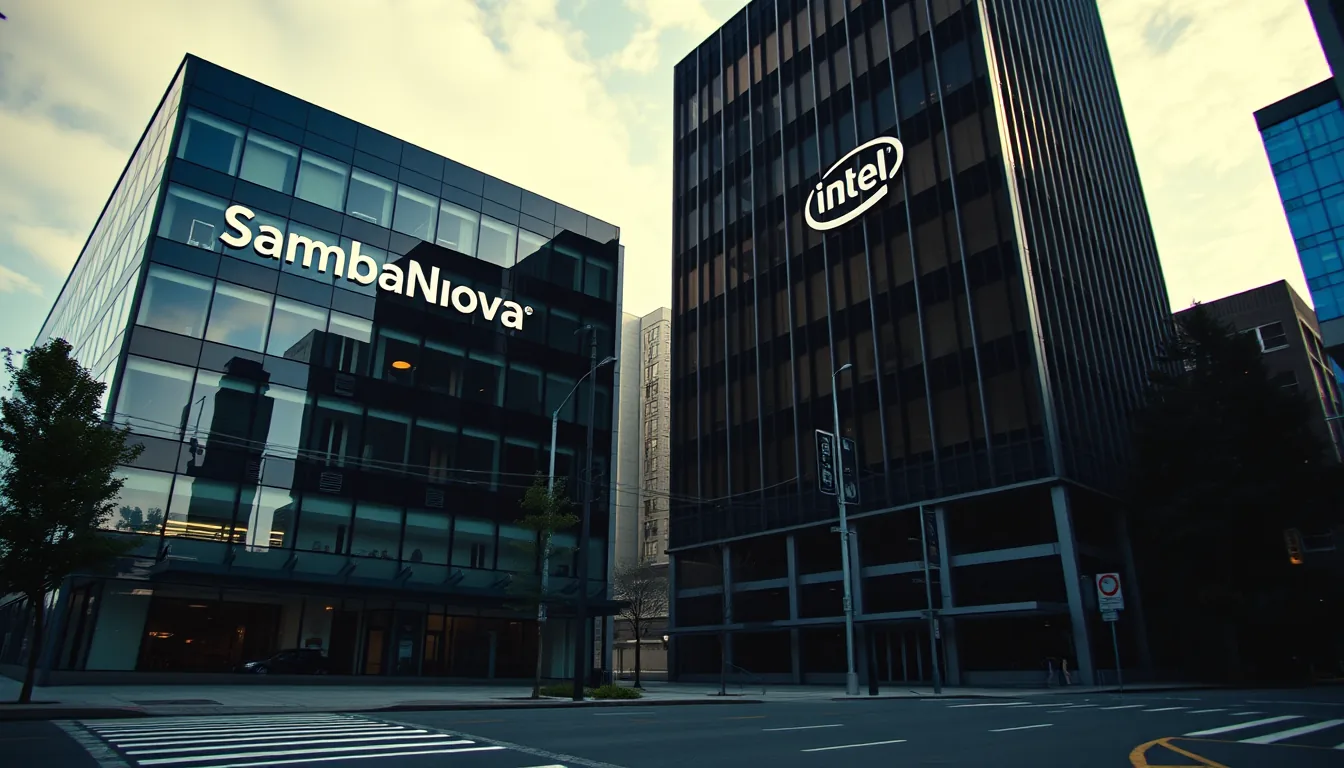
“SambaNova has raised at an $11B valuation months after Intel was rumored to be trying to buy it for about $1.6 billion.” Let that sink in for a second. We aren’t talking about a 20% premium or a slight bump in sentiment. We are talking about a valuation delta so wide it looks like a typo.
When a legacy giant like Intel—a company that literally defines the hardware landscape—looks at a firm and sees $1.6 billion, and then a group of VCs look at the same firm and see $11 billion, someone is hallucinating. (And it’s probably not the guys who have to deal with the physics of silicon). The gap here isn’t just a difference in opinion; it’s a different reality.
SambaNova is playing a high-stakes game of chicken with the market. Raising $1B in a Series F first close is one thing, but doing it at this valuation, so shortly after a previous mega-round, suggests a level of confidence that borders on the delusional. Or, more likely, it suggests that the current AI investment climate has completely decoupled from any semblance of traditional due diligence.
Why the discrepancy? It is possible Intel was just lowballing them, trying to snag a promising architecture for a bargain. But it is equally possible that Intel’s engineers looked at the actual silicon and decided the $1.6B price tag was already a stretch. When you are dealing with hardware, the friction is visceral. You cannot just “pivot” your way out of a bad architecture or a supply chain bottleneck. You need HBM, you need TSMC capacity, and you need a reason for a customer to stop buying H100s.
Looking at the TechCrunch report, the speed of these rounds is the real story. Five months between mega-rounds suggests either a desperate need for liquidity or a sudden, unexplained surge in demand that Intel somehow missed. Who is actually doing the math on these valuation jumps?
It is like a sports team paying a record-breaking transfer fee for a player who has spent the last three seasons on the bench. The hope is that the potential is there, but the price is based on a fantasy version of the future, not the current stats on the board.
This is a bubble.
The problem with $11B valuations is that they create a ceiling that is almost impossible to hit without becoming a top-three player in the global chip market. NVIDIA has the moat, the software ecosystem, and the distribution. Everyone else is just fighting for the scraps of the “non-NVIDIA” alternative market. If you are priced at $11B, you are no longer an alternative; you are supposed to be a contender.
But the hardware world does not work on venture capital optimism. It works on yield, latency, and power efficiency. If the performance does not scale linearly with the funding, the collapse is usually fast and loud. We have seen this movie before with the various AI hardware attempts of the last decade—companies that looked like giants on a slide deck but couldn’t survive the transition from a lab prototype to a data center rack.
(Or maybe they have found a way to optimize inference that makes the H100 look like a calculator—but they have not shown us that yet).
The market is currently pricing SambaNova as if they have already won the war. They have not. They have just raised a lot of money to keep fighting it. This level of capital is a double-edged sword: it allows for aggressive scaling, but it also removes the pressure to be lean and efficient. When you have a billion dollars in the bank, you can afford to ignore the red flags for a while.
By Q4, we will see if the actual enterprise adoption numbers justify this valuation or if the board has to explain why they paid a premium for a company that Intel thought was worth a fraction of the price. Until then, this is just a very expensive bet on a very crowded field.